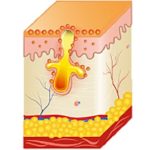
Dr.MAL is a PDT* product designed for professional use which consists of Methyl-ALA 13% and Panax Ginseng Callus Extract optimized for acne-prone skin types. Dr.MAL is a special treatment program which prevents fundamental causes of troubled skin and inhibits recurrence of skin problems.
*PDT(Photo Dynamic Therapy)
PDT refers to a treatment which applies a photosensitizer on skin that selectively permeates into sebaceous glands and pores, or which irradiates a certain wavelength or laser on skin in order to effectively destroy acne bacteria.
PRINCIPLE
|
Application of photosensitizer Troubled skin, blackheads, sebum, pore |
Photosensitizer is selectively absorbed by sebaceous glands. and acne bacteria. |
|
Irradiation of appropriate wavelength LED |
Selective destruction of acne bacteria Reduced sebaceous glands |
KEY INGREDIENTS
Dr.MAL
• MAL (Methyl-ALA) 13%
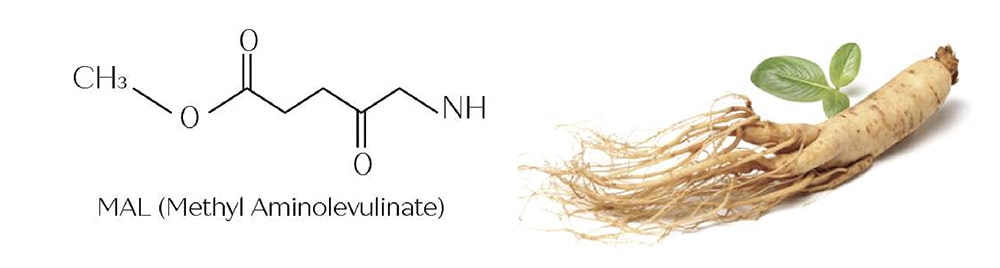
MAL refers to a lipophilic photosensitizer which is formed by adding Methyl to the commonly used ALA for enhanced stability. MAL has a high skin absorption rate which leads to maximization on effects and reduction in procedure time.
• Panax Ginseng Callus Extract
Panax Ginseng Callus Extract plays a role in protecting and recovering damaged skin from UV lights during irradiation.
POST Dr.MAL Cleanser
POST Dr.MAL Cleanser is the first MAL neutralizing cleans- er developed for professional use. Dr.MAL’s lipophilic MAL substance remaining on the skin is effectively removed by means of using the same type of lipophilic neutralizer. If applied following Dr.MAL treatment, it may help minimize possible side effects.
BEFORE & AFTER

REFERENCE
1. The great effect of MAL PDT
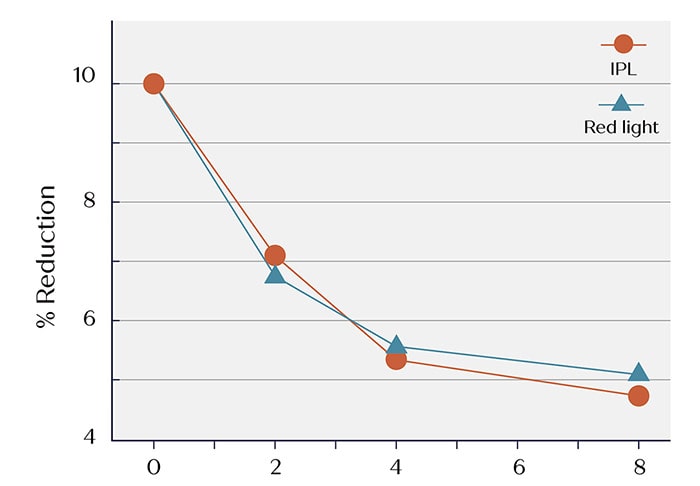
1) In case of using Methyl-ALA, it shows the same effect as IPL by just irradiating the LED.
2) It can be used easily when applied as a gel type.
 |
The Korean society for acne research, 2011:41 Acne treatment by methyl aminolevulinate photodynamic therapy with red light vs. intense pulsed light Jong Soo Hong, MD, Jae Yoon Jung, MD, MSc, Ji Young Yoon, MSc, and Dae Hun Suh, MD, PhD |
| Time (weeks) Fig 7. Visual analogue scale of subjective improvement (ranging from Io to o, in which Io was “same as before first treatment and o meant “currently with no acne”). IPL, intense pulsed light |
• Summary We analyzed the treatment outcome with two light sources (red light vs. IPL). After the first treatment, red light showed significantly decreased inflammatory lesions, compared with IPL (26 and 17% reduction, respectively). In conclusion, MAL-PDT with red light and IPL is both an effective and safe modality in acne treatment. Red light showed a faster response time than IPL. After multiple sessions, both light sources demonstrated satisfactory results. |
2. Reduced pain during MAL PDT
Methyl-ALA (MAL) shows a greater selective absorption rate for pathologic cells than ALA. MAL therefore causes less damage of healthy cells, resulting in less pain during irradiation.
Table 2. Porphyrin levels and distribution of porphyrin metabolites 6 h after substrate application*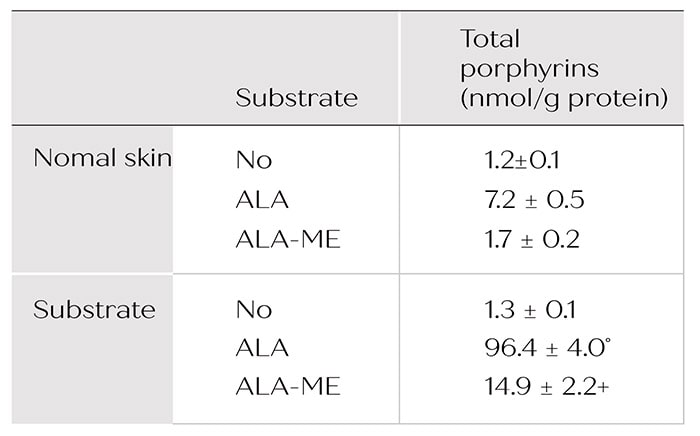 |
Photochemistry and Photobiology, 1998, 68(2):218-221 Preferential Relative Porphyrin Enrichment in Solar Keratoses upon Topical Application of 8-Aminolevulinic acid MethylesterFritsch C, Homey B, Stahl W, Lehmann P, Ruzicka T, Sies H • Summary |
| Photochemistry and Photobiology, 1998, 68(2):218-221 Preferential Relative Porphyrin Enrichment in Solar Keratoses upon Topical Application of d-Aminolevulinic acid Methylester Fritsch C, Homey B, Stahl W, Lehmann P, Ruzicka T, Sies H • Summary |
3. Increased skin absorption rate with lipophilic substance
Methyl-ALA(MAL) is a lipid component which consists of a non-polar chemical structure, therefore shows a greater skin penetration rate than existing ALA and responds selectively to skin.
Table 3. Depth of porphyrin fluorescence in lesions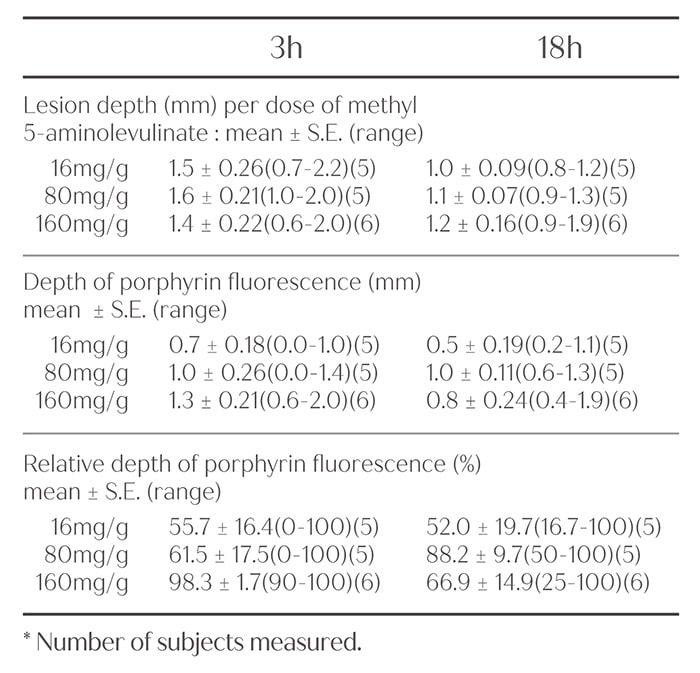 |
Journal of Photochemistry and Photobiology B: Biology 62 (2001) 140-145 Selective distribution of porphyrins in skin thick basal cell carcinoma after topical application of methyl 5-aminolevulinate Peng Q, Soler AM, Warloe T, et al. • Summary |
4. High satisfaction during MAL PDT
MAL, which consists of combination of ALA and Methyl derivatives, shows a greater prognosis than existing ALA.
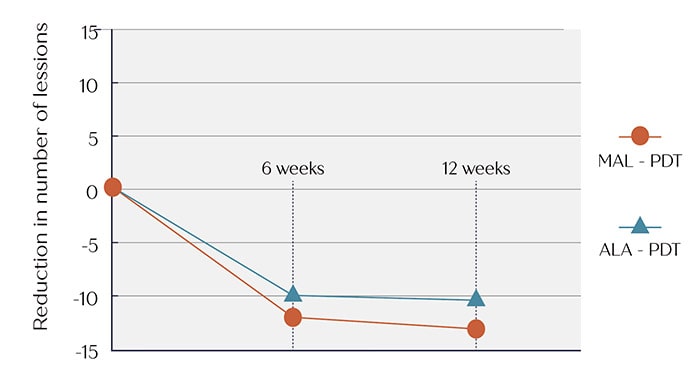 Fig 1. Median reduction in numbers or inflammatory lesion counts from baseline. |
J Am Acad Dermatol, 2006 Apr:54(4), 647-651 Photodynamic therapy of acne vulgaris using 5-amino- levulinic acid versus methyl aminolevulinate Wiegell SR, Wulf HC • Summary |
| J Clin Aesthet Dermatol. 2009 February; 2(2):44-47 Therapeutic and aesthetic uses of Photo Dynamic Therapy part five of a five-part series ALA-PDT and MAL-PDT, What makes them different Michael H. Gold. MD • Summary |
5. Improved safety during MAL PDT
Dr.MAL minimizes PDT side effects by means of using safe photosensitizer with optimal concentration level suited for acne-prone skin-types during PDT.
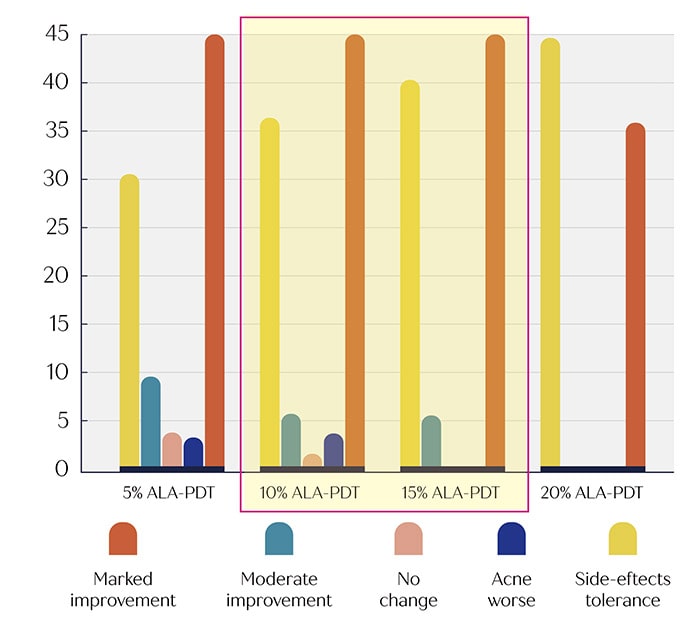 |
British Journal of Dermatology 2010 163, pp1064-1071 Investigation of optimal aminolaevulinic acid concentration applied in topical aminolaevulinic acid-photodynamic therapy for treatment of moderate to severe acne: a pilot study in Asian subjects R. Yin, F. Hao, J. Deng, X.C. Yang and H. Yan • Summary |
6. Minimization of side effect with POST Dr.MAL Cleanser
1) First in South Korea to use ALA neutralizer which led to minimization of side effects caused by overexpression of ALA remaining on skin.
2) By destroying ALA remaining on skin with the use of neutralizer, resuming daily activities is possible simply with application of UV protection.
| Korean J Lab Med 2002; 22(3): 163-168 A correlation of prothrombin time in citrated specimens and EDTA specimens examined by Owren Method Ahn, Je-Joon, Park, Joo-Won • Summary European Journal of Phamaceutical Sciences, 1999 Jan;7(2):87-91 • Summary
|