
What is NAD+
 |
Nicotinamide Adenine Dinucleotide (NAD) is a coenzyme that plays a key role as a mediator in redox reactions within cells. NAD+ is the cationic form of NAD that exists in cells. NAD+ is essential for energy production reactions in the mitochondria. By supplying Nicotinamide Mononucleotide (NMN), the concentration of NAD+ in the body is increased, which activates the sirtuin gene that delays cell aging, thereby producing an anti-aging effect. Its role:
• Cellular metabolism and energy production (ATP synthesis) As we age, NAD+ levels naturally decline, leading to reduced cellular energy and increased oxidative stress. |

NAD+ as Coenzyme
 |
Understanding the vital role of NAD+ in cellular redox reactions and energy production in mitochondria and its implications for skin health. 1. NAD+ acts as a key coenzyme in redox reactions. 2. It is essential for energy production in mitochondria. 3. As we age, NAD+ levels decline, impacting cellular function. |
Relationship between NAD+ & Skin

 |
Paired images of facial photographs and the autofluorescence of the granular layer at 22-um depth with two-photon tomography (bottom). The left-side images are the facial photograph and the two-photon image of a Japanese female subject aged 23 years, and right-side images are those of a Japanese female subject aged 67 years. There is more autoflourescence in the two-photon image of younger female skin (left image), indicating the presence of more NAD(P)H in the granular layer of younger female skin than in older female skin (right image). |

NAD+ and Energy Production
 |
Nicotinamide adenine dinucleotide (NAD+) is a vital coenzyme in mitochondrial energy metabolism. It functions as an essential electron carrier in oxidative phosphorylation, particularly in the electron transport chain (ETC), where it accepts electrons from metabolic substrates during glycolysis and the tricarboxylic acid (TCA) cycle, converting into NADH. NADH then donates electrons to Complex I of the ETC, initiating a cascade that ultimately generates adenosine triphosphate (ATP)—the cell’s primary energy currency.
Clinically, declining NAD+ levels with age or stress impair mitochondrial efficiency, reduce ATP production, and increase reactive oxygen species (ROS), leading to cellular senescence and tissue degeneration. By restoring NAD+ levels (via precursors like NMN or direct delivery), mitochondrial function is enhanced, oxidative stress is reduced, and cells regain bioenergetic capacity. This is especially relevant in high-turnover tissues like skin, where improved mitochondrial energy supports repair, regeneration, and anti-aging outcomes. |
Aging and NAD+ Levels
Energy Production
NAD+ is an essential part of metabolism (the reactions that turns food into the energy that cells need to maintain their vital functions). These metabolic reactions take place in the mitochondria which are the energy powerhouses of cells. Therefore, any drop in NAD+ will mean these mitochondria powerhouses won’t function as efficiently and there will be a decline in cellular energy.
Cellular Health
NAD+ also acts as a signal to switch on maintenance and repair pathways, including DNA repair. Just existing can be damaging to our cells so maintaining these repair mechanisms as we age is vital.
NAD+ does this by activating a group of proteins called “sirtuins”. Known as the “longevity genes”, the sirtuins are increasingly recognised as crucial to ageing well. In fact, these proteins are nicknamed the “guardians of the genome” because of the key role they play in maintaining cellular health and supporting healthy ageing. However, these proteins are entirely dependent on NAD+ for their activation.
In other words, sirtuins do not work without NAD+.
As we age, NAD+ availability decreases, leading to reduced energy production and compromised DNA repair.

How NAD+ Helps Create a Reverse Aging Effect on Skin:
 NAD+ helps reverse the visible and functional signs of skin aging by restoring the skin’s natural cellular functions that decline with age. It boosts mitochondrial energy production, which is essential for active cell repair and renewal. NAD+ helps reverse the visible and functional signs of skin aging by restoring the skin’s natural cellular functions that decline with age. It boosts mitochondrial energy production, which is essential for active cell repair and renewal. |
 NAD+ also activates sirtuins—key enzymes that regulate longevity genes, enhance DNA repair, and reduce cellular stress and inflammation. NAD+ also activates sirtuins—key enzymes that regulate longevity genes, enhance DNA repair, and reduce cellular stress and inflammation. |
 NAD+ promotes the regeneration of healthier, younger-looking skin cells. It increases collagen and elastin synthesis, strengthens the skin barrier, reduces oxidative damage from UV and pollutants, and improves skin texture and tone. NAD+ promotes the regeneration of healthier, younger-looking skin cells. It increases collagen and elastin synthesis, strengthens the skin barrier, reduces oxidative damage from UV and pollutants, and improves skin texture and tone. |
 Over time, this leads to smoother, firmer, and more radiant skin—mimicking a “reverse aging” effect both in appearance and at the molecular level. Over time, this leads to smoother, firmer, and more radiant skin—mimicking a “reverse aging” effect both in appearance and at the molecular level. |
NAD+ Functions and Benefits
By restoring NAD+ levels, the skin benefits from improved cell regeneration, enhanced collagen synthesis, reduced oxidative stress, and a visible reduction in signs of aging
Increasing NAD+ leading to improved cellular function and longevity.
Benefits and Features of NAD+ for Skin
 |
Anti-aging: Smoother, firmer, and more radiant skin |
 |
DNA protection & repair: Delays signs of photoaging and pigmentation |
 |
Improved skin hydration: Healthier, plumper skin texture |
 |
Strengthens skin immunity: Reduces frequency of breakouts and sensitivity |
 |
Restores cellular health: Enhances healing post-procedures (laser, RF, etc.) |
 |
Safe for long-term use: Sustains skin quality over time |

What does it consist of?
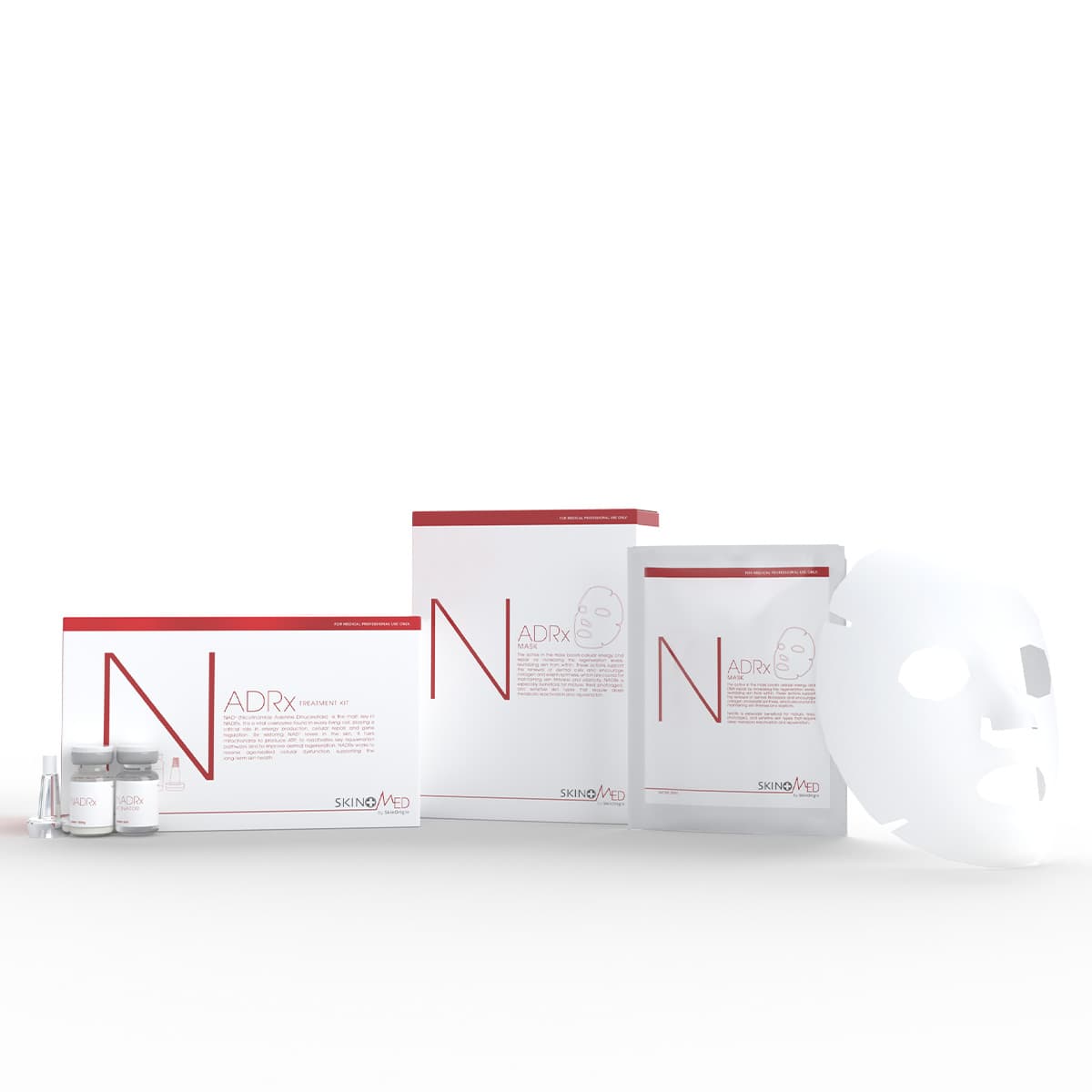
It consists 2 types of vials and a mask.
NADRx
It enhanced mitochondrial function and ATP production within dermal fibroblasts, thereby improving cellular metabolism and promoting collagen and elastin synthesis. It also supports DNA repair mechanisms and reduces oxidative stress, resulting in improved dermal integrity, skin resilience, and reduction of photoaging markers. This cellular-level rejuvenation contributes to long-term skin health and visible anti-aging effects.
NADRx Activator
The main active of NAD+ rejuvenate the skin by enhancing cellular energy production, boosting DNA repair, and stimulating collagen synthesis. This leads to improved skin texture, firmness, and radiance, while reducing signs of aging such as fine lines and dullness. The treatment supports skin regeneration at a deep cellular level, promoting long-term skin vitality.
NADRx Mask
The actives in the Mask works synergistically to lighten and firm the skin through multiple clinical pathways. They enhance collagen synthesis and dermal regeneration, improving skin firmness and elasticity. Simultaneously, they inhibit melanin production and transfer, reduce inflammation, and provide antioxidant protection—resulting in brighter, more even-toned, and visibly firmer skin.
Clinical Benefits
Enhanced Cellular Repair – Promotes DNA repair and cellular turnover, aiding in recovery from environmental and oxidative damage.
Improved Dermal Structure – Stimulates fibroblast activity, increasing collagen and elastin production, which enhances skin firmness and elasticity.
Anti-Inflammatory Action – Reduces inflammatory cytokines, helping calm skin conditions and supporting barrier function.
Increased Hydration and Radiance – Enhances skin metabolism and NAD+ levels in keratinocytes, resulting in improved hydration, texture, and skin glow.
Reduction in Fine Lines and Wrinkles – Supports long-term dermal regeneration, visibly diminishing signs of aging.
Protection Against Photoaging – Mitigates UV-induced damage by restoring intracellular antioxidant capacity and promoting skin resilience.
